
INEOS, together with partners Harbour Energy and the Danish North Sea Fund (Nordsøfonden), has officially opened Project Greensand, the European Union’s first full-scale commercial offshore CO2 storage site.
Inaugurated by King Frederik X of Denmark at a ceremony at the Port of Esbjerg on 18 September 2026, the project integrates CO2 capture, transport and permanent offshore storage.
Greensand is designed to store up to 400,000 tonnes of CO2 annually in its initial commercial phase, with potential capacity of 4-8 million tonnes per year at full capacity.
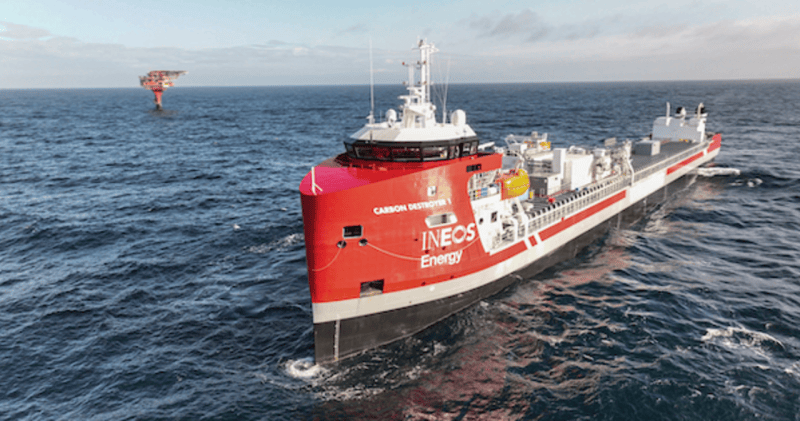
CO2 will be sourced primarily from Danish biomethane plants, liquefied and transported by truck to a dedicated terminal at the Port of Esbjerg. It will then be shipped aboard Carbon Destroyer 1, the EU’s first purpose-built CO2 carrier, and injected into the Nini West reservoir, a depleted oil field approximately 250 kilometres offshore and 1,800 metres beneath the seabed.
Sir Jim Ratcliffe, Chairman of INEOS, said: “Europe will not achieve net zero by closing factories and exporting its jobs. We need solutions that allow industry to remain competitive while reducing emissions. Greensand proves it can be done. This is not a pilot project, a concept or a political ambition. It is a fully operational carbon storage business. The technology works. The storage is ready. The challenge now is creating the right conditions for carbon capture to grow quickly at scale across Europe.”
Dan Jørgensen, European Commissioner for Energy and Housing, said: “With the launch, here in Esbjerg, of the first fully operational site for offshore carbon storage in the European Union, we prove that carbon storage is a practical reality. We show that we can move from demonstration to deployment. We set out a path for European industries: to continue their transition to a low-carbon future, while maintaining production, investments, and employment in our continent. And we open a new front in the existential fight against climate change.”
Project Greensand marks a significant step in the development of Europe’s carbon capture and storage infrastructure, demonstrating how maritime transport and existing offshore energy assets can support industrial decarbonisation.
In the photo: The Carbon Destroyer 1. Photo courtesy of Ineos