
After five years of research, development and industrial testing, the EU-funded ACCSESS project has concluded, delivering three innovations that could help some of Europe’s hardest-to-abate industries reduce their emissions and remove CO2 from the atmosphere.
The project focused on accelerating the deployment of CCUS technologies through three key innovations:
- CO2 capture technology that makes retrofitting easier and cheaper: A combination of an environmentally benign enzymatic solvent and a compact rotating packed bed (RPB) absorber was successfully tested at four industrial sites. During the final testing campaign in Poland, the system achieved a capture rate of 90%, capturing nearly two tonnes of CO2 per day. The technology could significantly reduce the footprint and operating costs of retrofitting existing industrial facilities.
- Turning captured CO2 and industrial waste into valuable products: Researchers demonstrated a process that combines captured CO2 with industrial mineral residues to produce high-purity precipitated calcium carbonate (PCC). The material can be used in industrial applications or as a form of CO2 storage, offering an opportunity to reduce emissions while creating value from industrial waste.
- Designing the cement plant of the future with integrated CO2 capture: The project developed and assessed six innovative cement kiln concepts that integrate CO2 capture into the production process while making use of waste heat. The concepts showed promising potential to reduce operating costs and could also be adapted to existing cement plants.
The results represent an important step towards industrial deployment. The first two innovations advanced to Technology Readiness Level (TRL) 7, demonstrating their potential in operational environments. The third established a fundamentally new approach to cement kiln design, with considerable potential for further development.
ACCSESS ran from May 2021 to August 2026 and focused on four hard-to-abate sectors: pulp and paper, waste-to-energy, cement and biorefineries. Coordinated by SINTEF Energy Research, the project brought together 18 industrial and research partners from eight European countries.
The project’s results demonstrate how international collaboration, technological expertise and real-world testing can accelerate the development of practical CCUS solutions, helping reduce industrial emissions and, in some cases, remove CO2 from the atmosphere.
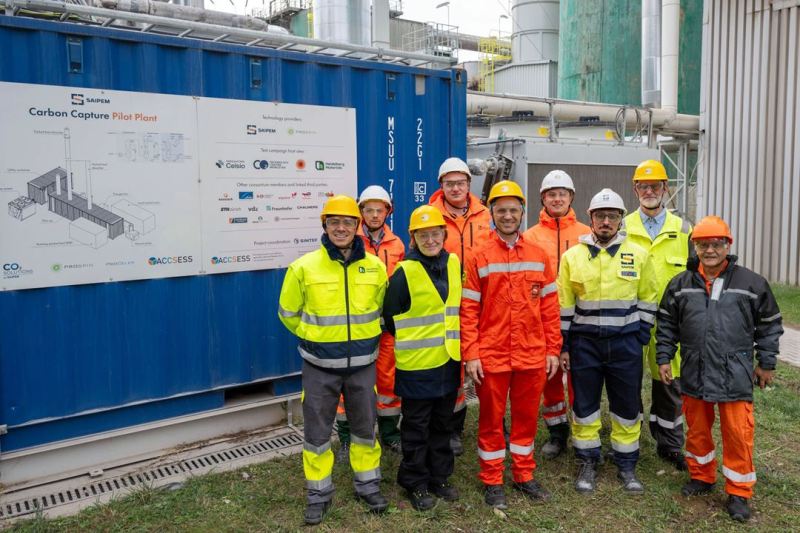
In the photo: Visit to the ACCSESS pilot rig at Heidelberg Materials in Górażdże, Poland, following the conclusion of the testing campaign for improved CO2 capture in April 2026. Photo courtesy of SINTEF