
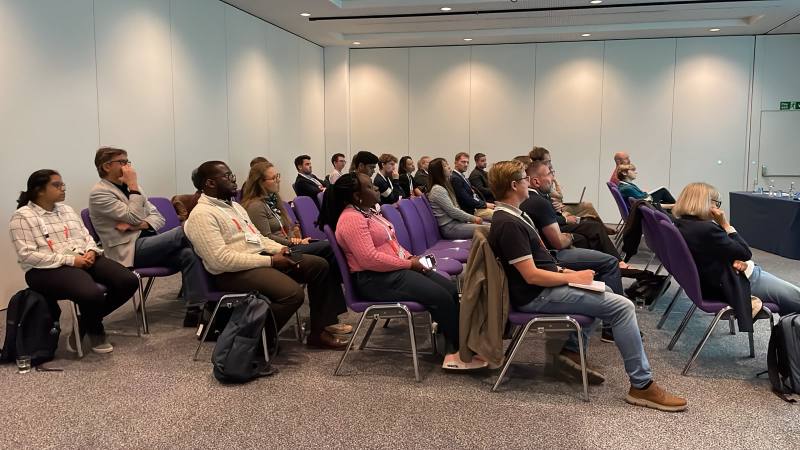
Artificial intelligence is opening up new possibilities across the CCUS value chain, from optimising carbon capture and system integration to enabling new approaches to subsurface modelling and monitoring. The Dedicated Session “AI for the CCUS Value Chain” at the 2026 World CCUS Conference, chaired by Sarah Perez (Heriot-Watt University, UK), explored both the opportunities and challenges of applying AI across the CCUS value chain.
The session brought together two complementary perspectives, looking at agentic AI for reservoir simulation and uncertainty-aware digital twins for CO2 storage monitoring, before opening up a broader discussion around reliability, physical understanding and the role of experts in the development and use of AI.
Francesca Watson (SINTEF Digital, Norway) explored the potential of agentic AI to automate and interact with reservoir simulation workflows, while emphasising the continuing role of experts in defining modelling intent, assessing physical relevance, and deciding when an agent’s proposed solution is geologically meaningful. Felix Herrmann (Georgia Tech, USA) presented an uncertainty-aware digital twin approach for CO2 storage monitoring using time-lapse seismic data, highlighting that the reliability of the digital twin depends directly on the physical models used to generate its training data. Uncertainty or misspecification in the underlying rock-physics models can affect how changes in CO2 saturation and pressure are inferred from seismic data, motivating the explicit representation of these physical uncertainties within the digital-twin framework.
These perspectives provided a natural starting point for a broader discussion on what responsible AI use should look like in CCUS. A recurring theme was that apparent confidence should not be confused with reliability: AI approaches require careful benchmarking, validation, and critical assessment, including consideration of model misspecification and the physical assumptions embedded in their training data. The discussion also reinforced the importance of keeping experts in the loop, alongside developing appropriate AI literacy through education and industrial training. An especially interesting point concerned reproducibility in the context of agentic AI. As agentic AI increasingly involves interactions between experts and autonomous agents, reproducibility may need to extend beyond preserving the final code and results to also recording the sequence of interactions, corrections and expert interventions that shaped the final workflow.
Overall, the session highlighted AI not as a replacement for physical modelling or human expertise, but as a powerful addition to them, provided that its assumptions and limitations are clearly understood and appropriately managed.