
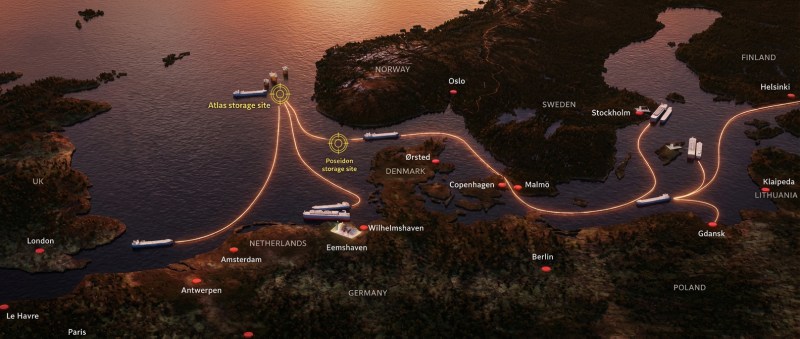
DNV has issued a Statement of Feasibility (SoF) for a concept developed by Aker BP and Höegh Evi to inject CO2 directly from shuttle carriers into subsea wells for permanent storage at the Atlas project on the Norwegian Continental Shelf (NCS).
Atlas aims to inject up to 6 million tonnes of CO2 annually in its initial phase, with an estimated total storage capacity of 150 million tonnes. Aker BP is targeting first injection around 2031, followed by more than 25 years of operation.
The concept involves shuttle carriers operated by Höegh Evi transporting liquefied CO2 directly to the offshore storage site for injection into the reservoir. This approach could avoid the need for new onshore facilities, cross-border pipelines and permanent offshore structures, offering a flexible and scalable alternative while retaining pipeline transport as a future option.
DNV assessed the offshore infrastructure required to transfer CO2 from the carriers into the reservoir, identifying the main technical challenges and uncertainties. These were considered manageable at this stage of development. The assessment followed DNV’s technology qualification methodology, DNV-RP-A203, and its CCS-specific framework, DNV-SE-0160.
The assessment builds on earlier DNV Approvals in Principle for Höegh Evi’s liquefied CO2 carrier and floating CO2 reception and conditioning terminal (FCSO), covering key elements of the value chain from CO2 aggregation and marine transport to offshore injection.
“Direct injection from ship to reservoir requires the marine, subsea and injection systems to function as one integrated value chain. While further verification and maturation work will be needed as the project progresses, our assessment demonstrates that the concept is technically feasible and provides a sound basis for continued development,” said Prajeev Rasiah, Senior Vice-President and Regional Director for Northern Europe, Energy Systems at DNV.
Under the proposed model, captured CO2 from industrial emitters would first be sent to a floating terminal operated by Höegh Evi for aggregation, purification and liquefaction before shipment. The terminal is designed for 40,000–80,000 m3 of intermediate storage, while each shuttle carrier could transport up to 50,000 m3 per voyage. At Atlas, an offshore loading system and subsea lines would transfer the CO2 directly into injection wells.
“Atlas is intended to connect industrial emitters in Europe with permanent, large-scale storage on the Norwegian Continental Shelf. The marine-based concept would allow that transport and storage chain to be developed in phases as volumes grow, supporting aggregation and scalable growth while retaining pipeline transport as a future option. DNV’s Statement of Feasibility is an important step as we continue to mature the project towards an investment decision,” said Ørjan Jentoft, Aker BP CCS Asset Manager.
Nils Jakob Hasle, EVP Clean Energy at Höegh Evi, added: “The industry requires flexible transportation solutions to access offshore CO2 storage. By integrating floating collection and conditioning infrastructure with large-scale shuttle transportation, this concept enables CO2 from multiple sources to be aggregated efficiently and delivered directly to permanent offshore storage.”
The EXL011 Atlas licence was awarded by the Norwegian Ministry of Energy in September 2024. Aker BP operates the licence with an 80% stake, alongside ORLEN (20%). Atlas was included in the European Commission’s second Union list of Projects of Common Interest and Projects of Mutual Interest in April 2026. In October 2026, Aker BP and Höegh Evi were awarded €223 million from the EU Innovation Fund to support the cross-border CO2 transport and storage network, subject to a Final Investment Decision (FID) in 2028.
Subject to investment decisions, Atlas is planned to begin operations in 2031. The marine-based direct-injection concept could also be applied at EXL005 Poseidon, Aker BP’s other operated CO2 storage licence on the NCS.
Photo courtesy of Aker BP