
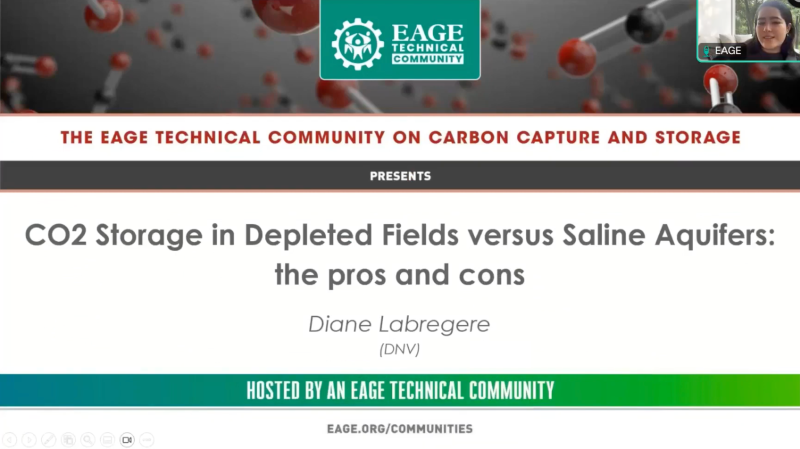
As carbon capture and storage (CCS) continues to scale globally, selecting the right geological storage site remains one of the most important decisions in any project. To explore this topic, the EAGE Technical Community on Carbon Capture and Storage recently hosted a webinar “CO2 Storage in Depleted Fields versus Saline Aquifers: The Pros and Cons” with guest speaker Diane Labregere (DNV).
CCS is widely recognised as a key technology in meeting global climate targets. However, the safety, feasibility, monitoring strategy and overall economics of a project are closely linked to the characteristics of the chosen storage formation. The session examined the two principal geological options currently used for CO2 storage.
Deep saline aquifers offer vast theoretical storage capacity and are widely distributed geographically, making them an attractive option for large-scale deployment. At the same time, they often require extensive site characterisation and careful assessment of injectivity and long-term containment.
Depleted hydrocarbon fields, by contrast, provide proven containment through known trap integrity and decades of production data. In many cases, existing wells and infrastructure can support development, although legacy well integrity and field-specific constraints must be carefully evaluated.
The webinar introduced the comparative advantages and challenges of both approaches and set the stage for deeper technical and economic discussion. By outlining key considerations for each storage type, the session provided valuable context for professionals involved in screening, developing, and regulating CO2 storage projects.
The webinar recording is available here.