
The Danish Energy Agency has granted its eighth permit for the exploration and possible storage of CO2 in Denmark to a consortium consisting of TotalEnergies, Mitsui and Nordsøfonden.
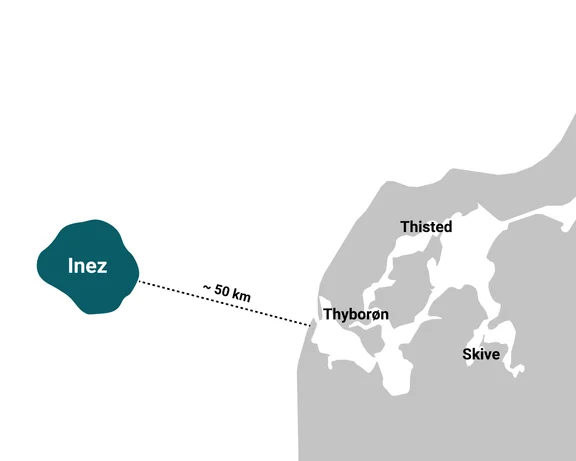
The permit covers the coastal Inez area, located around 50 kilometres offshore from Thyborøn, and allows the consortium to carry out exploration activities to determine whether the subsurface geology is suitable for long-term storage of CO2.
Under the permit, the consortium commits to initiating a full exploration programme to assess whether the geological formations beneath the seabed are suitable for CO2 storage. This includes detailed subsurface studies to evaluate capacity, integrity and containment. If the area proves viable, the permit provides the right to progress from exploration to the development of an actual CO2 storage project.
The permit was awarded by the Danish Energy Agency following a tender process and forms part of Denmark’s broader framework for establishing offshore CO2 storage. Peter Christian Baggesgaard Hansen, Deputy Director General of the Danish Energy Agency, highlighted: “Denmark’s subsoil is particularly suitable for safe and sound storage of CO2, and with the new permit, there are now eight areas in Denmark where work is being done to establish specific storage projects. Better access to storage in different parts of Denmark provides better conditions for realising CO2 capture and thus contributing with real reductions for the benefit of the climate.”
TotalEnergies provides the consortium with technical and operational capability. Its experience in offshore subsurface evaluation and project delivery provides a credible pathway from early exploration through to injection and long-term storage, should the site meet the required criteria.
Mitsui contributes long-term capital and project structuring capability. As a trading house accustomed to backing large-scale infrastructure aligned with policy objectives and international value chains, CCS fits naturally within its investment profile.
Nordsøfonden’s involvement signals continued state-level commitment. By maintaining a direct stake, Denmark reinforces the view of CO2 storage as strategic national infrastructure rather than a purely commercial opportunity.
Together, the consortium reflects a familiar infrastructure pattern: technical delivery, patient capital and public alignment. This combination is increasingly central to moving CO2 storage from exploration into system-scale deployment.
In the photo: the Inez area. Photo courtesy of Danish Energy Agency