
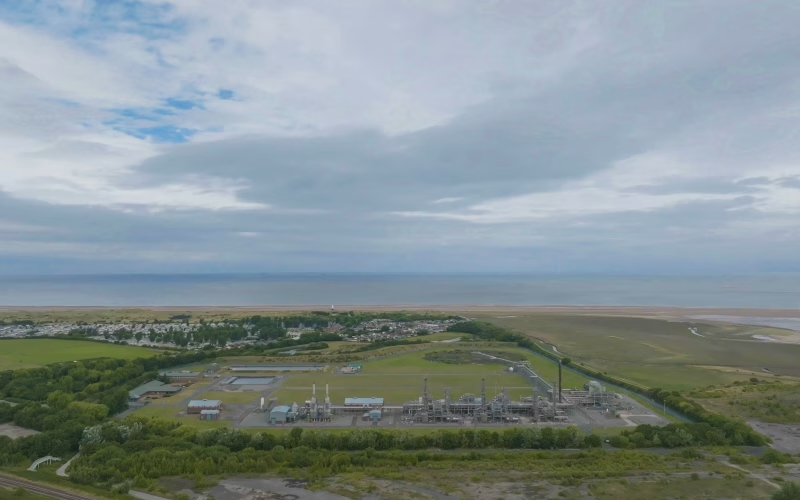
Liverpool Bay CCS Ltd, part of Eni CCUS Holding Group, has secured a seabed lease from The Crown Estate for the offshore carbon dioxide (CO2) transportation and storage infrastructure supporting the HyNet industrial decarbonisation cluster.
The agreement marks a milestone for the project, which is set to become the UK’s first carbon capture and storage (CCS) development to repurpose existing offshore oil and gas infrastructure for the permanent storage of CO2.
The lease grants Liverpool Bay CCS Ltd the rights to use the seabed for pipelines and geological storage beneath Liverpool Bay. The transport and storage network will serve industrial emitters across North West England and North Wales, transporting captured CO2 through a combination of new and repurposed infrastructure before injecting it into depleted natural gas reservoirs beneath the seabed for permanent storage.
The Liverpool Bay CCS project will repurpose more than 75 miles (~120 km) of existing offshore pipelines and two-thirds of its offshore platforms, while also constructing 21 miles (~33 km) of new pipeline to connect industrial emitters to the storage network.
Stefano Rovelli, Managing Director of Liverpool Bay CCS Ltd, said: “This lease with The Crown Estate is another important step for the Liverpool Bay T&S infrastructure which will serve the wider HyNet cluster. Repurposing our existing infrastructure helps to speed up the process by which we can tackle CO2 emissions from industry in the North West of England and North Wales, supporting economic growth in the region as part of the UK’s journey to net zero.”
Denise Moylan, CCS & Hydrogen Director at The Crown Estate, said: “This lease marks an important milestone for the Liverpool Bay CCS project and the development of carbon storage infrastructure in UK waters. While enabling the responsible use of the seabed and the repurposing of existing offshore infrastructure, the project can help hard-to-abate industries reduce emissions while supporting jobs, investment and industrial competitiveness in North West England and North Wales.”
Olivia Powis, Chief Executive of the Carbon Capture and Storage Association, said: “The Liverpool Bay CCS lease with The Crown Estate is yet another exciting step forward for UK CCUS deployment. Liverpool Bay shows how repurposing existing infrastructure for CCUS can accelerate the decarbonisation of hard-to-abate industries such as cement and energy-from-waste, while delivering skilled jobs. Sustaining momentum on deployment is now critical to delivering the UK’s industrial ambitions at scale.”
The project is expected to store up to 4.5 million tonnes of CO2 annually during its initial phase, with storage capacity planned to increase to around 10 million tonnes per year after 2030 as additional industrial users connect to the network.
According to the project developers, the development is also expected to support around 2,000 construction jobs and unlock approximately £2 billion in supply chain investment, contributing to industrial decarbonisation and economic activity across North West England and North Wales.
The seabed lease follows earlier project milestones, including the award of an agreement for lease in August 2024 and financial close in April 2025. Construction and infrastructure conversion activities are underway, with first CO2 injection targeted for 2028.
The Liverpool Bay CCS project forms the transportation and storage backbone of the HyNet industrial decarbonisation cluster, one of the UK’s first carbon capture and storage projects to receive government support for commercial deployment. By reusing existing offshore infrastructure, the project aims to accelerate the development of the UK’s CCS network while reducing the need for new offshore construction.
Image courtesy of The Crown Estate