
RaboResearch has released a two-part analysis of CCUS in Europe, providing a snapshot of technological, economic and policy factors shaping the sector. Their research underscores both the promise of CCUS as a climate solution and the significant hurdles still to overcome.
1. CCUS: Critical for hard-to-abate sectors
CCUS is essential to decarbonise industrial sectors such as cement, steel and chemicals, which are difficult to electrify.
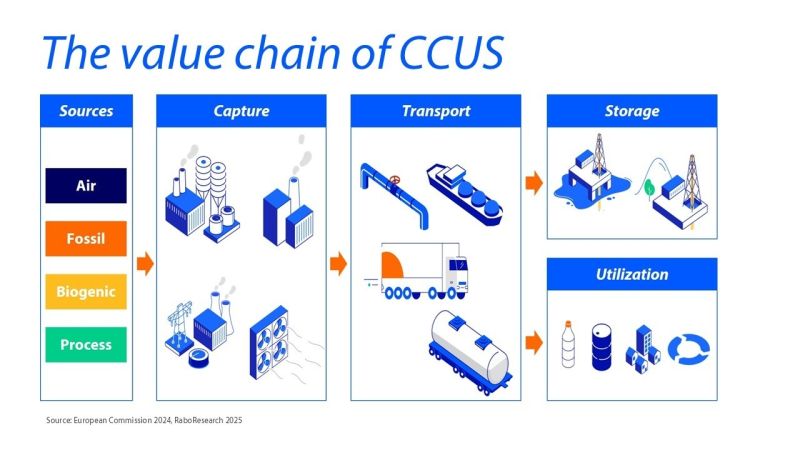
It enables CO2 to be captured at the source, stored underground, or converted into usable products, providing a versatile tool for Europe’s industrial decarbonisation pathway.
2. Europe’s pipeline: Ambitious and active, but early stage
Momentum in 2025 was tangible: operational capacity doubled in Norway and the Netherlands, and several projects reached final investment decision, including facilities like Stockholm Exergi’s BECCS plant in Sweden and Klemetsrud waste-to-energy capture in Norway.
Today, 240 projects are in development, with a combined capture capacity of approximately 482 m mt CO2 per year. While this demonstrates ambition, most projects remain early-stage: only a fraction is financed or under construction, and a large portion of the pipeline remains “undefined” due to limited data on viability.
Financing, permitting and risk-sharing are the main bottlenecks to turning ambition into operational capacity.
3. Economics: Costs remain the key barrier
Capture accounts for 60-70% of total project costs, with transport and storage also significant. Opportunities to reduce costs exist via technological innovation, modularisation and repurposing existing infrastructure, but these require investment and time.
Public funding continues to play a critical role, especially for early-stage projects, though targeted financing mechanisms, such as those in the UK, have successfully attracted private capital.
4. Technology and infrastructure
- Capture methods include pre-, post- and oxy-fuel technologies, each suited to different industrial emissions.
- CO2 transport infrastructure is still limited, especially for cross-border networks.
- Storage potential is high in regions like the North Sea, providing long-term containment.
- Emerging CO2 utilisation pathways, such as synthetic fuels or building materials, remain underutilised but offer promising value creation.
5. Policy and investment support: Strengthening CCUS visibility
2025 saw supportive policy and market signals that strengthened CCUS’s role in Europe:
- The Clean Industrial Deal boosted visibility and strategic focus.
- The EU’s 2040 target of 90% greenhouse gas reduction highlighted CCUS as a critical tool.
- New bilateral agreements enabled cross-border CO2 transport and storage.
- Public funding remained the backbone of financing, while the UK attracted private capital.
- Activity in voluntary carbon markets increased, demonstrating rising commercial interest.
National frameworks vary: the UK combines Contracts for Difference with risk-sharing mechanisms, the Netherlands and Denmark rely on EU ETS price-linked schemes, and Norway primarily uses grants and tax incentives. Harmonisation across Europe is limited, which can slow cross-border infrastructure and investment.
6. From ambition to implementation: 2026 will be decisive
Looking ahead, 2026 is a make-or-break year for CCUS in Europe. Key developments include:
- The EU will introduce a CO2 transport and storage framework, creating a regulatory structure to facilitate cross-border networks and streamline project development.
- The Net-Zero Industry Act will clarify injection and storage obligations for industrial emitters.
- The EU Emissions Trading System (ETS) may formally integrate carbon dioxide removals, strengthening CCUS project economics.
- Flagship projects are expected to go live in the Netherlands, Belgium and Germany, while additional BECCS projects are anticipated.
- CCUS applications connected to gas-fired power plants are expected to expand.
- Rising ETS prices will make CCUS projects more economically viable.
Scaling Europe’s CCUS sector will require accelerated permitting, de-risked financing and effective integration across capture, transport, utilisation and storage.
Conclusion
Europe’s CCUS sector has enormous potential, but converting the ambitious pipeline into operational projects is the key challenge. With 2025 momentum and critical developments expected in 2026, Europe stands at a pivotal moment: bridging financing, permitting and risk-sharing gaps will determine whether CCUS can fully contribute to achieving climate targets and industrial decarbonisation goals.
Source:
- RaboResearch Carbon capture, utilization, and storage in Europe – Part 1: A critical tool for decarbonization
- RaboResearch Carbon capture, utilization, and storage in Europe – Part 2: Costs, financing and the race to scale up